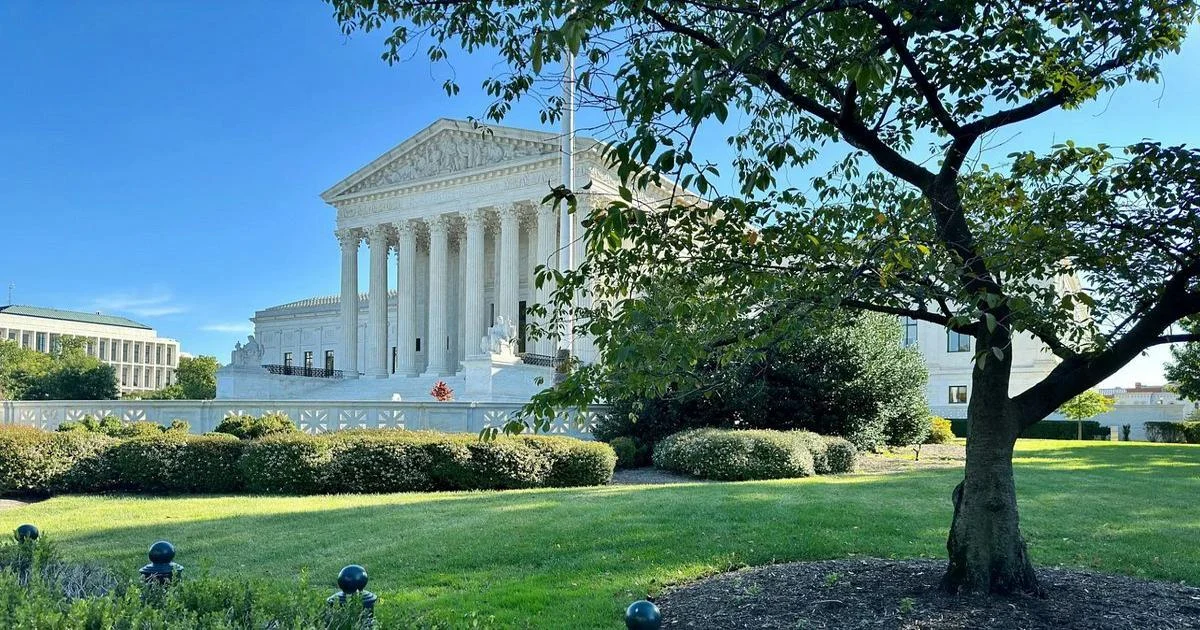
(The Center Square) — The U.S. Supreme Court on Friday agreed to hear a case challenging President Trump’s order banning asylum claims at the U.S.-Mexico border.
Justices on the high court agreed to hear Mullin v. Refugee and Immigrant Center for Education and Legal Services, a case centered around the Trump administration’s 2025 policy banning migrants from claiming asylum at the southern border.
The order was implemented on Jan. 20, 2025, Trump’s first day in office during his second term. Under the order, anyone who crosses the border without necessary paperwork can be removed without the ability to claim asylum.
Solicitor General John Sauer argued the president had inherent authority to restrict asylum for immigrants. He also said Congress gave authority for the president to have discretionary authority over asylum claims.
“That proclamation rests on a commonsense understanding of the President’s inherent and delegated powers to exclude aliens,” Sauer wrote in a petition to the high court. “Moreover, the [Immigration and Nationality Act] makes clear that asylum is a purely discretionary benefit.”
However, lawyers for the Refugee and Immigrant Center for Education and Legal Services argued that the Trump administration created an additional discretionary authority that was not authorized by Congress to employ.
“The government cannot evade Congress’s limits on eligibility bars by creating a categorical ban on asylum and labeling it an exercise of ‘discretion,’” the lawyers wrote. “When a group of noncitizens can never receive asylum, no ordinary speaker of English would say they are ‘eligible.’”
The case will be added to the high court’s docket amid a slew of immigration and asylum issues on the docket. On Nov. 30, the court will hear Wassily v. Blanche, a case challenging whether immigrants who received asylum can obtain lawful permanent resident status after the asylum status was terminated.
“The Attorney General may terminate asylum for a host of reasons – several of which rest entirely outside an asylee’s control,” lawyers for two immigrants involved in the case wrote in a petition to the high court. “Many of these former asylees and derivative spouses and children may have established strong ties to the United States over a long period of time.”
Justices on the high court will likely hear Mullin v. Refugee and Immigrant Center for Education and Legal Services in early 2027. A decision is expected in the case by June 2027.
This article was originally published by The Center Square and is republished under its open-access guidelines.