
Tuesday’s blue wave was not simply a victory for Democrats. It was an emphatic repudiation of President Trump and the MAGA movement, delivered by an electorate tired of paying more for groceries, more for gasoline, and more for a foreign war that they view as a breach of their trust.
However, Republicans would be making a serious mistake if they read the results as a rejection of conservatism. What Tuesday showed is that MAGA and conservatism are not the same thing, and that voters will not overlook the difference forever.
Donald Trump has made MAGA synonymous with his presidency. But the Republican Party existed long before Trump, and its founding principles do not change because the president has adopted a different set of priorities. Limited government, free enterprise, fiscal restraint, and a healthy skepticism of foreign intervention are not optional accessories to conservatism. They are its identity.
When MAGA abandons those principles, it should not be surprised when voters abandon MAGA.
Voters didn’t need an economics degree to see the problem
Trump was elected in 2024 in large part because Americans were tired of inflation and the rising cost of living. They wanted cheaper groceries, affordable gasoline, and an economy that rewarded their work instead of eating their paychecks.
Instead, they got sweeping tariffs and an expensive, unpopular war with Iran.
Tariffs are taxes on imports. Whatever their intended benefits, they impose costs that get passed along to American businesses and consumers. They are fundamentally at odds with the free-market principle that voluntary exchange and competition, not government intervention, should decide which businesses succeed.
The war in Iran was the same contradiction in uniform. Americans who backed Trump because he promised to stay out of unnecessary foreign conflicts instead watched their country sink into another costly military undertaking, with consequences for energy prices and household budgets.
The public noticed.
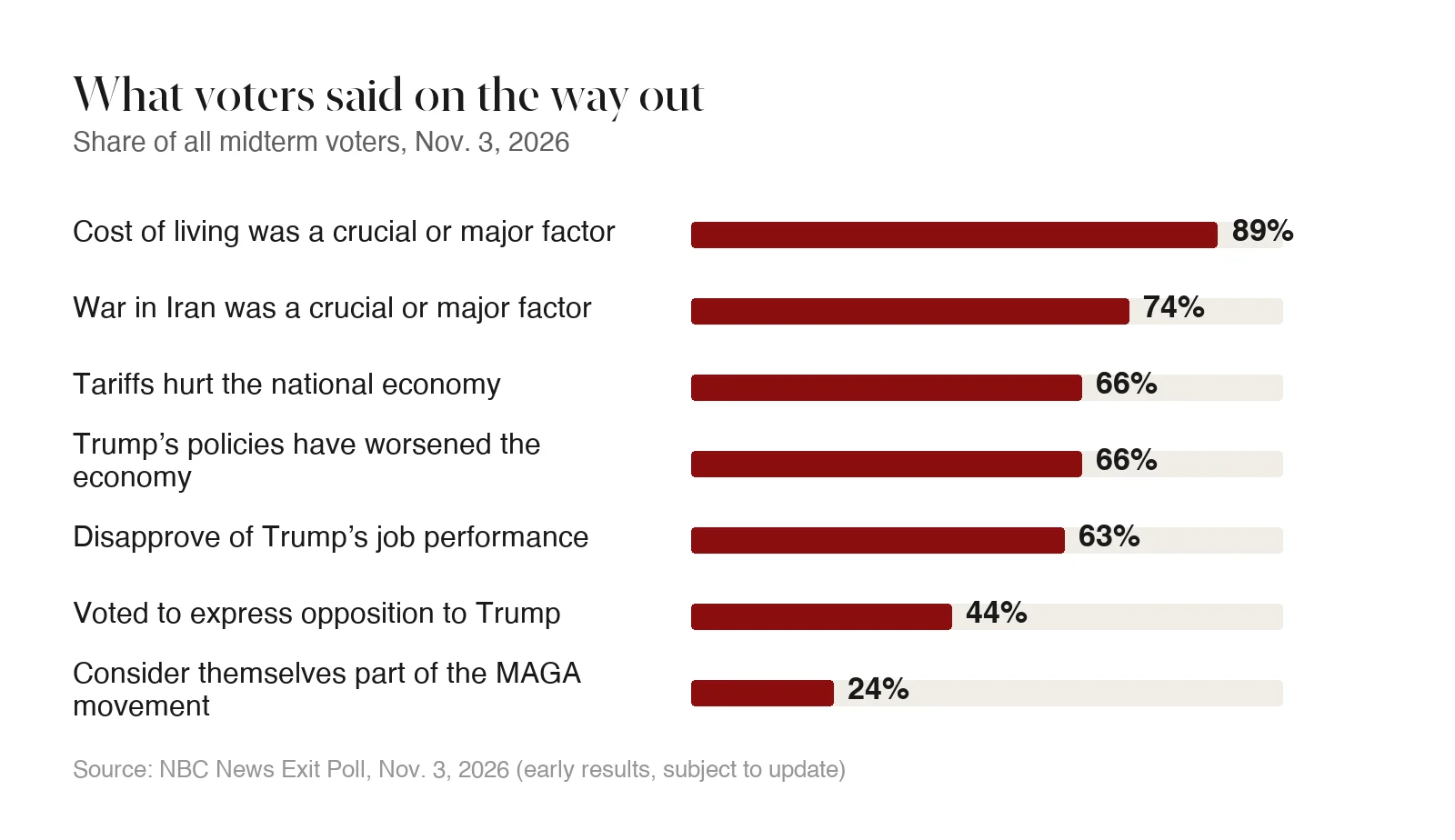
In the NBC News exit poll, 89% of voters said the cost of living was a crucial or major factor in their vote, and 74% said the same about the war in Iran. Three-quarters rated the economy as not so good or poor. Two-thirds said tariffs had hurt the national economy, and 66% said Trump’s policies had worsened economic conditions, against 27% who said they had improved them. Sixty-three percent disapproved of the president’s job performance.
Ask voters why they voted as they did and the answer is just as blunt: 44% said their House vote was meant to express opposition to Trump. Only 16% said it was to express support.
These were not obscure policy disagreements confined to think tanks and editorial boards. They were the concerns of ordinary Americans meeting the consequences of political decisions every time they filled the tank or bought groceries.
Even Republicans are losing confidence
The clearest evidence of MAGA’s political vulnerability was visible before a single vote was counted.
Pew Research Center had asked Republicans and Republican-leaning independents three times whether they believed Trump’s tariffs would have a mostly positive effect on the country. In August 2025, 52% said yes. By January it was 49%. In the survey Pew fielded from Sept. 28 to Oct. 4, it was 40%, with 34% expecting mixed results and 26% expecting outright harm.
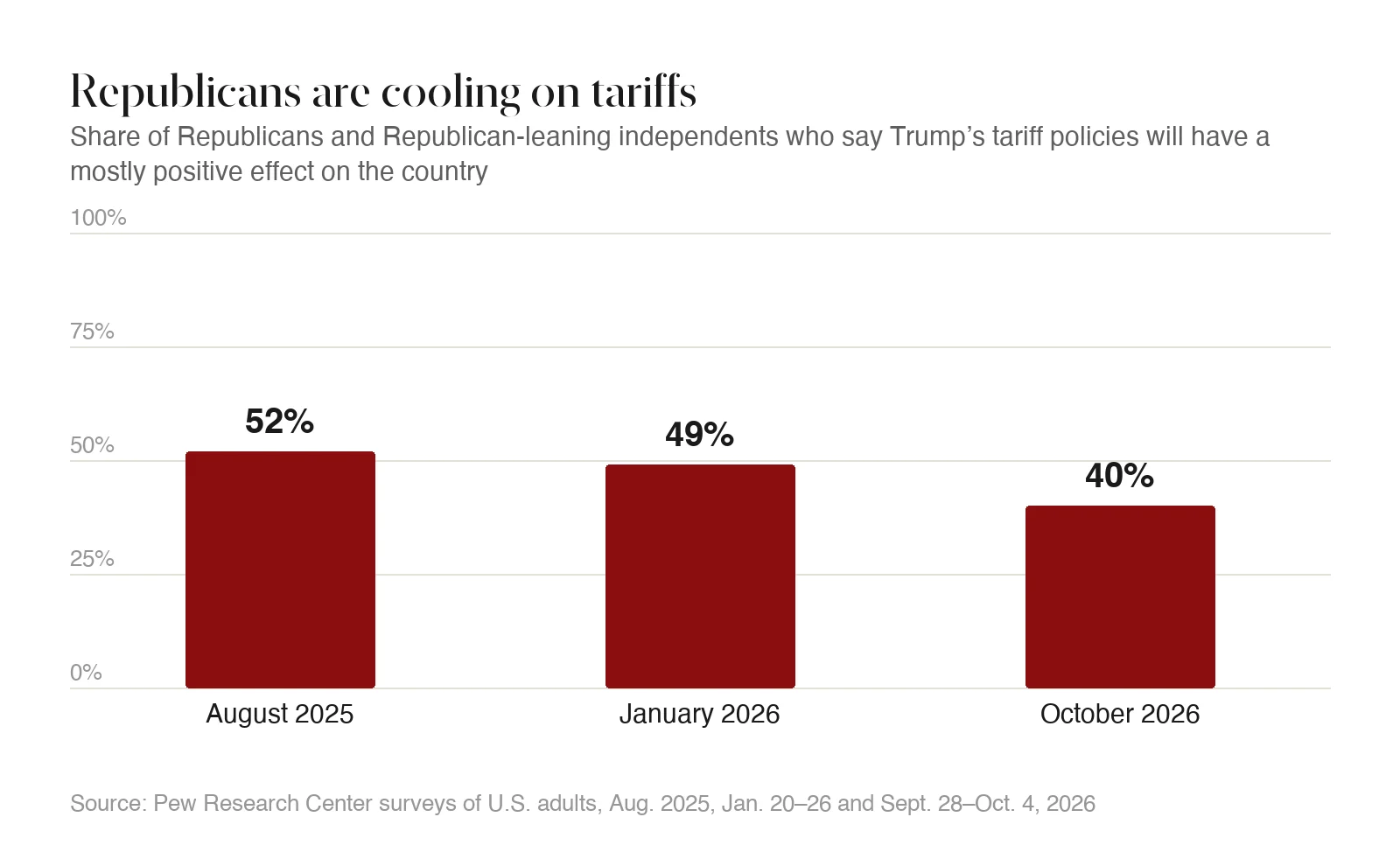
By Election Day, in other words, six in ten Republicans had a negative outlook regarding the tariffs. A Cato Institute survey of 4,150 registered voters in August found that 66% of Republicans said tariffs had raised prices, not far behind the 84% of Democrats who felt the same way.
The Iran war exposed even more cracks. Pew found that Republican approval of Trump’s handling of the conflict fell from 69% in March to 63% in October.
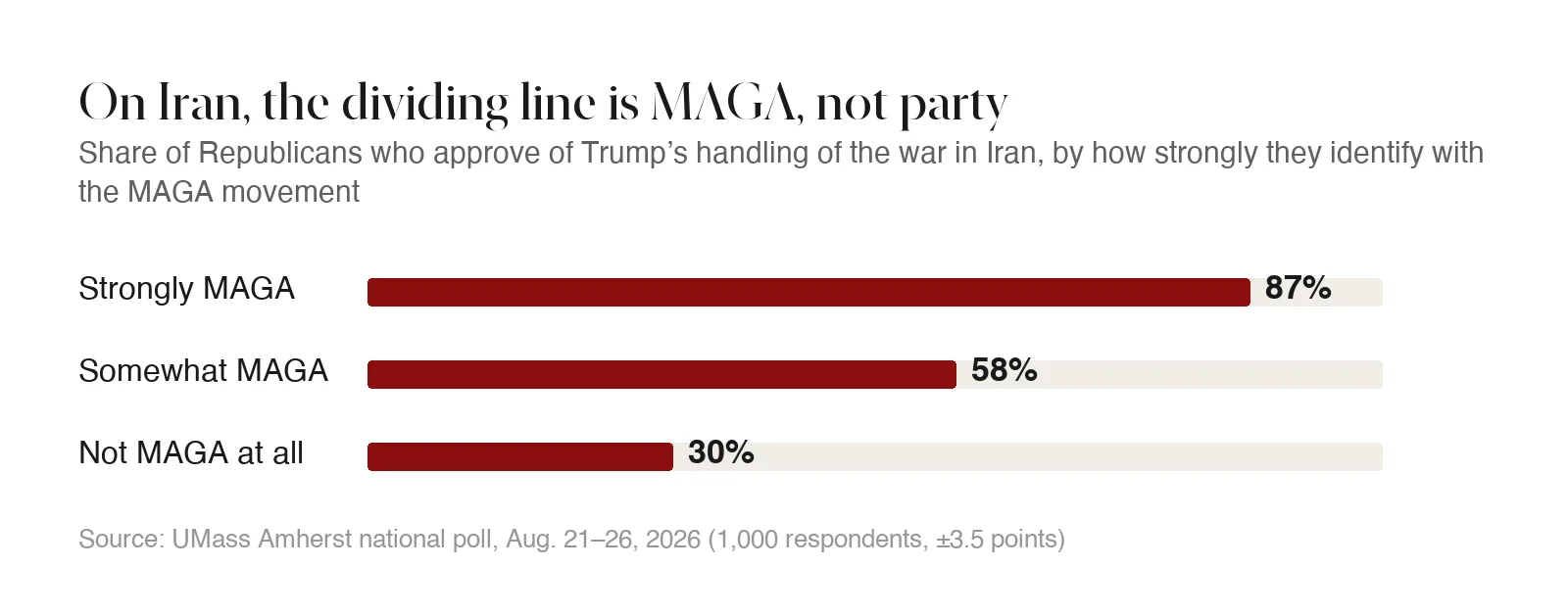
An August University of Massachusetts Amherst poll showed how much Republican attitudes depended on identification with MAGA. Among Republicans who strongly identified with the movement, 87% approved of Trump’s handling of Iran. Among those who identified as somewhat MAGA, approval fell to 58%. Among Republicans who did not identify with MAGA at all, it was 30%.
That distinction matters, and the exit polls show how much of the party it covers. Just 24% of midterm voters said they consider themselves part of the MAGA movement, while Republicans and Republican-leaning voters made up 43% of the electorate. Even if every MAGA voter was a Republican, more than four in ten Republican-leaning voters were not.
The Republican Party is not MAGA, and supporting a president is not an obligation to defend every decision he makes. A conservative can support border security, lower taxes, individual liberty and free enterprise without supporting protectionist trade barriers or a prolonged foreign war.
Tuesday’s results should bury the idea that voters will follow Trump wherever he chooses to lead them. Independents, a third of the electorate, broke for Democrats 58% to 38%.
Democrats won the election. That doesn’t mean voters embraced their policies.
The electorate plainly wanted change, and Democrats were the available alternative. But voting against the party responsible for the current economy is not the same as endorsing every policy the opposition offers.
The AP Voter Poll found that just under half of voters had a favorable opinion of the Democratic Party; the NBC exit poll put it at 47% favorable to 52% unfavorable. CBS News found that about one in five voters who backed Democratic House candidates still viewed the party unfavorably. Asked which party they trusted to handle the economy, voters gave Democrats only a six-point edge, 43% to 37%.
That is hardly an electorate united around a progressive economic agenda.
The silver lining for conservatives
There is an opportunity buried in Tuesday’s defeat, although Republicans may have trouble seeing it through the wreckage.
The election showed that MAGA cannot take the electorate for granted. Voters who elect a Republican president do not surrender their economic principles, their judgment or their right to hold him accountable, and that is a healthy lesson for any political movement.
Democrats now face the same test. Voters have placed their hopes in a party that, polls show, they do not especially like, because they are desperate for relief from high prices. When Democrats enact policies that restrict our energy supply, reopen the borders, and expand benefits programs, the tide will swing again.
Will the Republican party answer with more MAGA or with real conservatism?